- Today
Certified Exit Planning Advisor: How They Help Business Owners Prepare for a Successful Exit
- Elizabeth Kinsley
- 0 comments

Summary
A Certified Exit Planning Advisor (CEPA) helps business owners prepare for a future sale, succession, or ownership transition. The credential, awarded through the Exit Planning Institute (EPI), equips professionals with a structured approach to aligning business value, personal financial goals, and life after ownership. A CEPA can assess a company's readiness, identify opportunities to improve transferable value, and coordinate with other professionals involved in the exit process. For business owners, working with a qualified advisor early can help reduce last-minute challenges, strengthen the business, and create a transition strategy that reflects both financial objectives and personal priorities.
Introduction
Building a successful business often takes years of hard work. Owners invest time, money, and personal effort into developing customer relationships, managing employees, improving operations, and growing revenue. Yet many spend considerably less time preparing for the day they eventually leave the business.
An ownership transition can involve more than finding a buyer and agreeing on a price. Owners must consider what the business is worth, whether it can operate without them, how the proceeds will support their financial future, and what they want life after ownership to look like.
This is where a Certified Exit Planning Advisor can help.
A CEPA brings a structured approach to exit planning, helping business owners evaluate their company's current position and prepare for a future transition. Rather than focusing exclusively on the transaction, the process considers business performance, personal financial readiness, and the owner's long-term goals.
For law firm owners and other professional service business owners, this planning can be particularly important because business value may depend heavily on personal reputation, client relationships, and the owner's day-to-day involvement.
What Is a Certified Exit Planning Advisor (CEPA)?
A Certified Exit Planning Advisor (CEPA) is a professional who has completed the credentialing program offered by the Exit Planning Institute (EPI).
The designation is designed for professionals who advise business owners on preparing for an eventual exit. These professionals may come from different backgrounds, including law, accounting, financial planning, business consulting, and business brokerage.
The CEPA program teaches the Value Acceleration Methodology, a framework that connects three important areas of an owner's future:
Business value: Improving the company's financial performance, operational strength, and transferability.
Personal financial readiness: Understanding whether the owner's personal financial position supports the intended exit.
Life after business: Preparing for the personal and professional changes that follow an ownership transition.
The central idea is that exit planning should not begin only when an owner decides to sell. It should be part of the business's longer-term development.
A CEPA helps owners identify what needs attention today so that they have more options when they eventually decide to transition.
What Is a CEPA's Training and Qualification?
The CEPA credential is awarded through a structured educational and examination process administered by EPI.
According to the institute, its program is a five-day training experience that introduces participants to the Value Acceleration Methodology. The curriculum helps advisors understand how to assess business readiness, identify value gaps, and coordinate planning across business, personal, and financial considerations.
Participants study topics such as:
Business value assessment.
Owner readiness and personal financial objectives.
Identifying and reducing business risks.
Building transferable business value.
Developing an actionable exit strategy.
Coordinating with a multidisciplinary advisory team.
Candidates must complete the program requirements and pass the CEPA examination to earn the designation. The credential provides a framework for exit planning, but it does not replace the professional qualifications required for legal, accounting, investment, or tax advice.
It is also important to understand that earning the CEPA designation does not automatically establish expertise in every industry or transaction type. Business owners should evaluate an advisor's professional background, relevant experience, and ability to work with other specialists.
What Does a Certified Exit Planning Advisor Do?
A CEPA helps business owners prepare for an eventual transition by examining the company, the owner's financial position, and the personal goals that will shape the exit.
The specific services depend on the advisor's professional background and engagement, but the role generally involves several important activities.
1. Assess the Business's Current Position
Before recommending an exit strategy, an advisor needs to understand the company's current condition.
This may involve reviewing:
Revenue and profitability.
Cash flow and financial reporting.
Customer concentration.
Management structure.
Employee retention.
Operational processes.
Owner involvement.
Existing legal and contractual obligations.
The assessment helps identify strengths that support business value and weaknesses that could make a future transition more difficult.
For example, a consulting firm may generate strong revenue but rely on its founder to manage nearly every major client relationship. A CEPA can help identify this dependency as an area that needs attention before the business is marketed to buyers.
2. Identify Opportunities to Build Business Value
A major part of exit planning involves improving the company's ability to generate sustainable earnings and operate independently of its owner.
A CEPA may help the owner identify opportunities such as:
Improving profit margins.
Reducing unnecessary operating expenses.
Diversifying the customer base.
Strengthening recurring revenue.
Developing a capable management team.
Documenting important business processes.
Reducing dependence on the owner.
These improvements can strengthen the company's transferable value and make it easier for a buyer or successor to take over.
However, value creation is not guaranteed. The impact of each improvement depends on the business, market conditions, and how successfully the changes are implemented.
3. Align Business Goals With Personal Financial Objectives
A business sale may represent a significant part of an owner's retirement or long-term financial plan.
An owner may want to sell for a particular amount, retire within five years, continue working during a transition period, or transfer the business to a family member.
A CEPA helps bring these objectives into the exit planning conversation.
For example, a business owner may believe the company needs to sell for $8 million to support retirement. A review of the business's current value and personal financial position may reveal that the owner needs to improve profitability, adjust the exit timeline, or consider a different transition structure.
The advisor helps connect the business strategy with the owner's broader goals. Financial planners and tax professionals can provide specialized guidance on personal wealth, retirement planning, and tax implications.
4. Develop a Structured Exit Strategy
Not every business owner wants to sell to an outside buyer. Depending on the company's structure and the owner's objectives, possible exit routes may include:
Sale to an external buyer.
Management buyout.
Sale to an existing business partner.
Family succession.
Employee ownership or another internal transition.
Merger with another business.
A CEPA helps the owner evaluate the available paths and consider what preparation each option requires.
For example, a family succession may require developing the next generation of leadership, while a third-party sale may require preparing financial records, reducing owner dependency, and identifying potential buyers.
The appropriate strategy depends on the company's circumstances and the owner's personal and financial priorities.
5. Coordinate the Advisory Team
An ownership transition often requires input from several professionals.
A CEPA can help coordinate the work of:
Attorneys: Address legal structures, ownership agreements, transaction documents, and contractual obligations.
CPAs and tax advisors: Review financial statements, tax exposure, and transaction-related tax considerations.
Financial planners: Evaluate retirement needs and personal financial readiness.
Business valuation professionals: Assess the company's value using appropriate valuation methods.
Business brokers or M&A advisors: Identify potential buyers, market the business, and facilitate a sale.
The CEPA's role is generally to help keep the planning process aligned. The advisor does not replace these specialists or automatically perform their professional services.
6. Prepare for Unexpected Ownership Transitions
Not every exit happens according to schedule.
An owner may face an unexpected health issue, disability, partnership dispute, or unsolicited acquisition offer. Without preparation, these situations can create pressure and limit available choices.
A CEPA can help business owners consider different transition scenarios and identify steps that reduce disruption.
This may include documenting management responsibilities, developing succession arrangements, reducing reliance on key individuals, and maintaining financial and operational records.
Preparing for unexpected events can also make the business more resilient during normal operations.
How the CEPA Value Acceleration Methodology Works
The Value Acceleration Methodology is the framework taught through EPI's CEPA program. It connects business improvement with the owner's personal and financial objectives.
EPI describes the methodology through three main stages: Discover, Prepare, and Decide.
Stage 1: Discover
The Discover stage focuses on understanding the business's current value and the owner's objectives.
The advisor and business owner assess:
The company's current financial and operational position.
Factors affecting transferable value.
Business risks and dependencies.
The owner's personal and financial goals.
Areas requiring improvement before an exit.
This assessment creates a starting point for a prioritized action plan.
Stage 2: Prepare
During the Prepare stage, the owner works with the advisory team to implement improvements.
The focus may include:
Strengthening financial performance.
Improving operational efficiency.
Developing management capabilities.
Reducing business risks.
Building customer and employee relationships.
Improving the owner's personal financial readiness.
EPI describes the use of structured 90-day implementation periods to help owners make progress on these priorities.
Stage 3: Decide
The Decide stage helps the owner evaluate whether the business and personal circumstances support an exit or whether further value-building work is appropriate.
Possible decisions include:
Preparing for a sale.
Continuing to grow the business.
Pursuing an internal succession.
Considering a different ownership transition.
The objective is to make the decision based on the owner's goals and the company's readiness rather than reacting to external pressure.
Why Law Firm Owners May Benefit From Working With a CEPA
Law firms have several characteristics that can make exit planning more complex than a conventional business sale.
A firm's value may depend on its founding attorney's reputation, professional relationships, referral sources, client retention, and involvement in ongoing matters.
If clients work primarily with the owner, a prospective buyer may question whether those relationships will continue after the transition.
A CEPA can help law firm owners identify and address these challenges as part of a broader exit strategy.
Reduce Dependence on the Founding Attorney
A law firm that relies on one attorney for business development, client relationships, management, and legal work may be difficult to transfer.
Developing other attorneys and managers, documenting internal processes, and distributing client relationships can help reduce this dependency.
Strengthen Financial Performance
Law firm owners should understand the factors that influence profitability, including collections, staffing costs, practice area performance, revenue concentration, and operating expenses.
Improving these areas can help demonstrate the firm's financial stability to potential buyers.
Improve Client and Matter Continuity
Client relationships and ongoing matters need careful attention during an ownership transition.
Documented procedures, appropriate delegation, and a capable team can support continuity. Any transfer must also comply with applicable professional conduct rules and client confidentiality requirements.
Prepare for a More Transferable Practice
A law firm that operates through documented systems and a capable team may be easier for a successor or buyer to manage.
This can strengthen the firm's overall readiness for a transition, although no particular valuation or sale outcome is guaranteed.
CEPA vs. Business Broker: What Is the Difference?
A CEPA and a business broker may both participate in an owner's exit journey, but they generally serve different purposes.
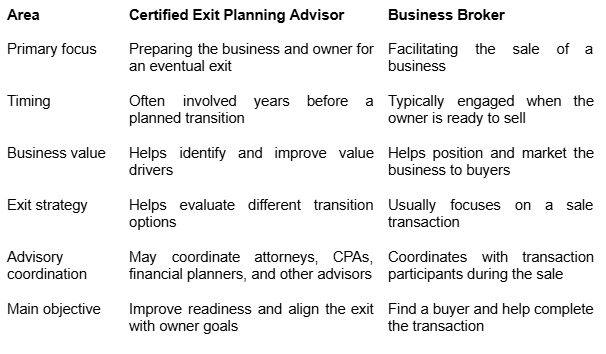
A CEPA does not replace a business broker. Instead, the two may work together when the owner is ready to enter the market.
An owner who is several years away from selling may benefit from exit planning first. Once the business is ready, a broker or M&A advisor may help identify buyers and manage the sale process.
When Should a Business Owner Hire a CEPA?
Business owners do not need to wait until they have selected a sale date to begin exit planning.
In fact, starting early provides more time to improve the business and prepare for different transition options.
A CEPA may be particularly useful when:
The owner expects to retire or sell within three to five years.
The company depends heavily on the owner's daily involvement.
The business needs stronger management or operational systems.
The owner is unsure what the company is worth.
A family member or employee may take over the business.
The owner has received an unsolicited acquisition offer.
The business has grown significantly and needs a more structured succession strategy.
Even owners who do not intend to sell soon can benefit from understanding what makes their business transferable. Many of the improvements involved in exit planning can also strengthen day-to-day operations.
What to Look for When Choosing a Certified Exit Planning Advisor
The CEPA designation provides a foundation in exit planning, but choosing the right advisor requires evaluating more than the credential itself.
Relevant Industry Experience
Look for an advisor who understands the business's industry and its specific ownership transition challenges.
For example, a law firm owner may benefit from an advisor familiar with professional service businesses, attorney-client relationships, and the considerations involved in transferring a legal practice.
A Clear Planning Process
Ask how the advisor assesses business value, identifies weaknesses, and develops an actionable plan.
A structured methodology can help owners understand what happens at each stage and how progress will be evaluated.
Ability to Coordinate Other Professionals
Exit planning involves legal, financial, tax, and operational considerations.
A strong advisor should understand when to involve other specialists and be willing to coordinate with the owner's existing professional team.
Relevant Transaction and Advisory Experience
Ask about the advisor's experience helping businesses prepare for ownership transitions.
Relevant experience may include business valuation, succession planning, practice sales, or working with owners through a completed exit.
Understanding of Personal Goals
The best exit strategy is not necessarily the one that produces the highest headline sale price.
Owners should work with an advisor who considers their financial needs, preferred timeline, family circumstances, and plans for life after the business.
How Quid Pro Quo Law Supports Law Firm Owners Through Exit Planning
For law firm owners, exit planning requires an understanding of both the business and the professional responsibilities involved in transferring a legal practice.
Quid Pro Quo Law works with law firm owners on valuation, profitability, succession planning, and practice sales.
Its founder, Victoria Collier, holds the Certified Exit Planning Advisor designation and brings firsthand experience from building and selling her own law practice. This combination of legal knowledge, exit planning training, and practical ownership experience informs the firm's work with attorneys preparing for a transition.
The firm helps law firm owners evaluate questions such as:
What is the practice worth today?
Which factors may be limiting its value?
How dependent is the firm on its founding attorney?
What operational improvements could strengthen transferability?
Which exit or succession options align with the owner's goals?
For owners who are considering retirement, a future sale, or a change in ownership, this type of planning can help establish a clearer path forward.
Frequently Asked Questions
1. What is a Certified Exit Planning Advisor (CEPA)?
A Certified Exit Planning Advisor is a professional who has completed the CEPA credentialing program offered by the Exit Planning Institute. The designation equips advisors with a framework for helping business owners prepare for a sale, succession, or other ownership transition.
2. What does a CEPA do for business owners?
A CEPA helps assess business readiness, identify opportunities to build transferable value, align business and personal financial goals, and coordinate the professionals involved in an exit. The specific services depend on the advisor's background and engagement.
3. How is a CEPA different from a financial advisor?
A financial advisor typically focuses on investments, personal wealth, and financial planning. A CEPA uses an exit planning framework that connects the business's value and readiness with the owner's personal and financial objectives. The professionals may work together as part of the same advisory team.
4. Is a CEPA the same as a business broker?
No. A CEPA generally helps prepare the business and owner for an eventual transition, often years before a sale. A business broker typically focuses on finding buyers and facilitating the transaction when the owner is ready to sell.
5. When should I work with a Certified Exit Planning Advisor?
Starting three to five years before an intended exit can provide time to improve profitability, reduce owner dependency, strengthen management, and prepare financial records. However, owners can benefit from beginning the process earlier, even if they have no immediate plans to sell.
6. Does a CEPA determine how much my business is worth?
A CEPA may help assess business value and identify factors that influence it. However, a formal valuation may require a qualified valuation professional, depending on the purpose and complexity of the engagement.
7. Can a CEPA help with law firm succession planning?
Yes. A CEPA with relevant law firm experience can help owners consider succession options, reduce dependence on the founding attorney, strengthen management, and coordinate the professionals involved in a practice transition. Legal and ethical requirements still need to be addressed by appropriately qualified professionals.
Conclusion
Preparing a business for an ownership transition involves more than finding a buyer. Owners need to understand what their company is worth, identify risks, improve transferable value, and consider how the transition will affect their personal and financial future.
A Certified Exit Planning Advisor provides a structured approach to bringing these considerations together. By beginning the process early, business owners can address weaknesses, strengthen operations, and evaluate different exit options before a transition becomes urgent.
For law firm owners, working with an advisor who understands professional service businesses can be particularly valuable. A well-prepared practice is not only better positioned for a future transition but can also become more stable and less dependent on its founder in the years leading up to it.